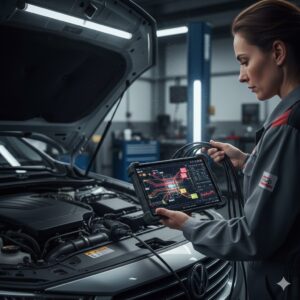
When something goes wrong with a car, the instinctive response is often to guess the cause. A warning light appears, a system stops working, or the vehicle behaves differently, and assumptions quickly follow. It must be the battery. Maybe a sensor. Possibly a fuse. Sometimes those guesses are right. Often, they’re not.
Modern vehicles are complex systems where mechanical and electrical components are deeply interconnected. Relying on guesswork in this environment doesn’t just waste time — it can create new problems. This is why proper diagnostics have become far more valuable than trial-and-error repairs.
Cars no longer fail in obvious ways
Years ago, vehicle issues were often easier to identify. A flat battery meant the car wouldn’t start. A blown fuse stopped a specific function. Today’s vehicles behave differently.
Electronic systems can fail partially or intermittently. A problem might only appear under certain conditions, such as when the engine is warm, during braking, or while using multiple electrical systems at once. Without proper diagnostics, these issues are easy to misread.
This is why people increasingly turn to an automotive electrician Marrickville professional when electrical faults don’t follow clear patterns. Modern diagnostics help pinpoint the real cause rather than chasing symptoms.
Guesswork often replaces the wrong part
One of the biggest risks of guessing is unnecessary part replacement. When a fault isn’t properly identified, components are often swapped out “just in case”.
This can lead to:
- Spending money on parts that weren’t faulty
- Masking the original problem temporarily
- Creating new faults through incorrect installation
Replacing parts without confirmation rarely fixes the underlying issue. It just moves the problem around.
Diagnostics reveal patterns humans miss
Modern diagnostic tools don’t just show fault codes. They reveal data patterns that aren’t visible through basic inspection.
Diagnostics can show:
- Voltage irregularities over time
- Communication errors between control modules
- Sensor readings that fall outside expected ranges
These insights allow technicians to see how systems behave together, not just in isolation. This is something guesswork simply can’t replicate.
Electrical issues rarely have single causes
A common misunderstanding is believing every problem has one clear cause. In reality, electrical faults are often the result of multiple small issues working together.
For example:
- A weak ground connection combined with moisture
- Slight corrosion paired with vibration
- Aging wiring interacting with new components
Diagnostics help identify these layered problems. Guessing usually focuses on the most obvious symptom, not the full picture.
Warning lights don’t tell the whole story
Dashboard warning lights are useful, but they’re only indicators. They don’t explain why a fault occurred.
A warning light may be triggered by:
- A genuine component failure
- A communication issue elsewhere in the system
- A temporary condition that no longer exists
Without diagnostics, it’s easy to misinterpret what the light actually means and respond incorrectly.
Time saved upfront prevents bigger delays later
Some people avoid diagnostics to save time or money. Ironically, this often leads to longer repair times.
Guess-based repairs tend to involve:
- Multiple visits
- Repeated testing
- Ongoing unresolved issues
Proper diagnostics usually shorten the overall process by directing repairs accurately from the start.
Modern vehicles depend on data accuracy
As vehicles become more software-driven, accurate data interpretation matters more than mechanical intuition. Systems rely on precise inputs to function correctly.
If those inputs are wrong — even slightly — performance suffers. Diagnostics allow technicians to verify whether data flowing through the system matches what the vehicle expects.
Without that verification, repairs are based on assumptions rather than evidence.
Diagnostics protect long-term reliability
Fixing a problem correctly the first time does more than restore function. It protects the vehicle from long-term damage.
Incorrect repairs can:
- Stress other components
- Cause repeated faults
- Reduce system reliability over time
Diagnostics reduce this risk by ensuring changes are made for the right reasons.
When experience works best with tools
Experience still matters. A skilled technician knows what to look for and how to interpret results. But experience without diagnostics is limited, just as diagnostics without experience can be misleading.
The strongest outcomes come from combining:
- Practical knowledge
- Structured testing
- Data-backed decision-making
This balance removes guesswork without removing human judgement.
Why certainty matters more than speed
Quick fixes can feel satisfying, especially when a problem appears to go away. But certainty is what keeps vehicles running reliably.
Diagnostics provide that certainty. They turn vague symptoms into clear causes and prevent small issues from becoming expensive ones later.
In a world where vehicles are more complex than ever, guessing is no longer efficient. Understanding what’s actually happening beneath the surface is what leads to smarter repairs, better outcomes, and far less frustration in the long run.